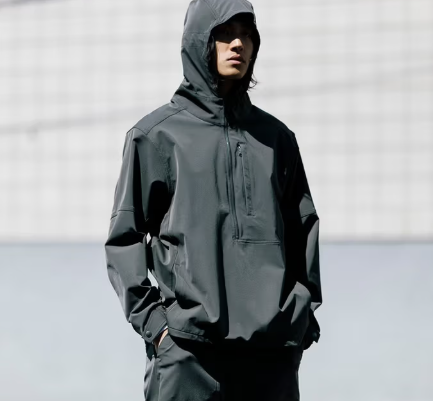
The Foundation of Waterproof and Breathable Technology
Modern outdoor gear is no longer defined by bulk, but by the sophisticated engineering of its molecular structure. At the forefront of this revolution is the ePTFE (expanded Polytetrafluoroethylene) membrane, most famously utilized by GORE-TEX. This technology functions on a deceptively simple principle: the membrane contains billions of microscopic pores that are significantly smaller than a water droplet, yet large enough to allow water vapor molecules to escape.
The GORE-TEX Standard
- Waterproof Integrity: Engineered to withstand extreme hydrostatic pressure, ensuring no liquid water penetrates the garment.
- Breathable Architecture: Facilitates the evacuation of perspiration, preventing the “greenhouse effect” inside the jacket during high-exertion activities.

Advanced Thermal Regulation and Phase Change Materials
Temperature management has moved beyond simple insulation. Technologies like Outlast® utilize Phase Change Materials (PCM) to actively balance the microclimate between the skin and the fabric. Originally developed for NASA to protect astronauts from extreme temperature fluctuations, these materials store excess heat when you are warm and release it when you begin to cool down.
How Phase Change Works
When the body temperature rises, the micro-encapsulated wax within the fabric melts, absorbing heat energy. As the body cools, the material solidifies, releasing that stored energy back to the skin. This dynamic cycle creates a buffer zone, extending the comfort range of a single garment across varying environments.

Specialized Fabric Structures: Fleece and Windproof Innovation
Polartec has fundamentally altered the outdoor landscape by moving away from traditional wool-based insulation toward high-loft, synthetic fibers. Their innovation lies in the “air pocket” architecture, which traps body heat without adding weight or restricting breathability. Beyond warmth, their windproof laminates provide a secondary shield against convective heat loss.
Engineering the Perfect Mid-Layer
- Loft Management: By utilizing hydrophobic synthetic fibers, these materials retain their insulative properties even when damp—a critical advantage over traditional down.
- Wind Resistance: Advanced lamination techniques allow for a 100% windproof barrier that remains air-permeable enough to prevent overheating.

Industry Leaders and Material Science Benchmarks
Manufacturers like Columbia and Schoeller represent the intersection of consumer accessibility and laboratory-grade performance. Columbia’s Omni-Heat technology, for instance, focuses on reflective thermal management, using metallic dots to bounce radiant body heat back toward the wearer. Meanwhile, Schoeller focuses on the “Swiss-made” precision of 4-way stretch, eco-friendly finishes, and extreme abrasion resistance.
| Technology | Primary Function | Best Application |
|---|---|---|
| GORE-TEX | Waterproof/Breathable | Extreme alpine conditions |
| Outlast | Thermal Regulation | Variable intensity sports |
| Omni-Heat | Radiant Heat Retention | Cold-weather activewear |
Frequently Asked Questions (FAQ)
- Q1: Why is breathability as important as waterproofing?
- If a fabric is waterproof but not breathable, moisture from sweat becomes trapped inside, causing the wearer to become wet from the inside out, which leads to rapid cooling and potential hypothermia.
- Q2: How do phase change materials (PCM) differ from standard insulation?
- Standard insulation is passive—it traps heat. PCM is active; it dynamically absorbs, stores, and releases heat to maintain a constant, comfortable skin temperature.
- Q3: Does washing affect the performance of high-tech fabrics?
- Improper washing can clog membranes. Always use technical detergents that do not leave residue, and reactivate DWR (Durable Water Repellent) coatings with heat as per manufacturer instructions.
- Q4: Is “waterproof” an absolute term in textile engineering?
- In high-performance gear, “waterproof” refers to a specific hydrostatic head rating. Fabrics are tested to see how much water pressure they can withstand before leakage occurs.