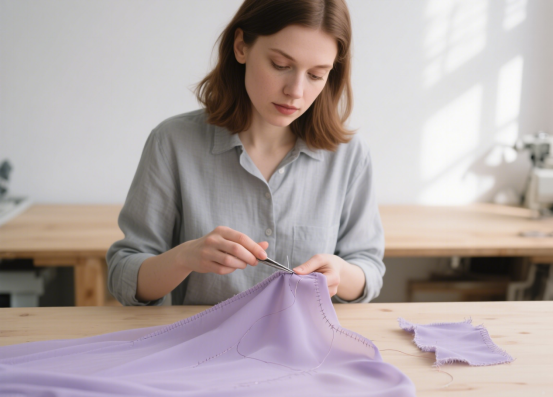
For many beginners, the excitement of starting a new sewing project is often dampened by technical hurdles like sudden thread breakage, frustratingly skipped stitches, or fabric puckering. These issues are rarely the fault of the sewing machine itself; rather, they are typically the result of a mismatch between the needle, the thread, and the fabric. Understanding the intricate relationship between these three elements is the foundational skill that separates an amateur from a professional. This guide provides an exhaustive deep dive into the mechanics of needle selection and thread quality to ensure every stitch you lay down is perfect.
Mastering the Fundamentals of Sewing Needle Selection
The sewing needle is the primary point of contact between your machine and your fabric. Choosing the wrong type can lead to permanent damage to your materials. Needles are categorized primarily by their point shape and their size. A Universal Needle features a slightly rounded point that is sharp enough to pierce woven fabrics but tapered enough to slide between the yarns of many knits. However, for specialized projects, you must look beyond the universal option.
The Anatomy of a Sewing Needle
To troubleshoot effectively, one must understand that a needle consists of several critical parts: the shank (the top part that fits into the machine), the shaft (the body), the eye (where the thread passes through), and the point. If the eye is too small for the thread, friction will cause the thread to shred. If the point is too dull, it will “punch” through the fabric rather than piercing it, leading to the audible “thumping” sound often heard when a needle needs replacing.
Specialized Needle Types
- Ball Point Needles: Designed specifically for rib knits and interlock fabrics. The rounded tip pushes fibers aside rather than cutting them, preventing “runs” or holes in the knit.
- Sharp (Microtex) Needles: These have a very slim, acute point. They are essential for microfiber, silk, and coated materials where precision is required to avoid snagging.
- Jeans/Denim Needles: These feature a reinforced blade to reduce needle deflection and a sharp point to penetrate thick, heavy layers without bending.

Understanding Needle Sizes and Fabric Weight Compatibility
Needle sizing is typically expressed in two numbers, such as 70/10 or 90/14. The first number is the European metric size (diameter in hundredths of a millimeter), and the second is the American size. The general rule of thumb is: the lighter the fabric, the smaller the needle number.
Size Correlation Chart
| Fabric Weight | Recommended Needle Size | Typical Fabric Examples |
|---|---|---|
| Very Light | 60/8 – 70/10 | Chiffon, Organza, Fine Lace |
| Medium Light | 75/11 – 80/12 | Cotton Voile, Poplin, Gingham |
| Medium Heavy | 90/14 | Linen, Velvet, Lightweight Denim |
| Heavy | 100/16 – 110/18 | Canvas, Upholstery, Heavy Denim |
Using a size 90/14 needle on a delicate silk (which requires a 60/8) will leave visible holes in the fabric. Conversely, using a 70/10 needle on heavy denim will almost certainly result in a snapped needle as the metal shaft fails to penetrate the dense weave.

Diagnosing and Fixing Thread Breakage and Skipped Stitches
Thread breakage and skipped stitches are the most common complaints among novice sewists. While it is tempting to adjust the machine tension immediately, the solution is often found in the needle or the thread path. Skipped stitches occur when the sewing machine hook fails to catch the thread loop behind the needle. This is frequently caused by a needle that is slightly bent—even if the bend is invisible to the naked eye.
Common Causes of Thread Breakage
- Burrs on the Needle: If a needle hits a pin or the throat plate, it can develop a tiny hook or “burr.” This burr will snag the thread every few stitches, causing it to fray and snap.
- Incorrect Threading: If the thread is not seated properly in the tension discs or if the bobbin is inserted backward, the resulting uneven resistance will break the thread.
- Old or Low-Quality Thread: Thread has a shelf life. Old cotton thread becomes brittle over time. Additionally, “bargain” threads often have inconsistent thicknesses (slubs) that catch in the needle eye.

The Science of High-Quality Sewing Thread Selection
Not all threads are created equal. A high-quality thread should be smooth, consistent in diameter, and have high tensile strength. When evaluating thread, look for long-staple polyester or mercerized cotton. Mercerization is a chemical treatment that increases the strength of the cotton and gives it a lustrous appearance, while also helping it better absorb dyes.
Identifying Professional-Grade Thread
To test thread quality, pull a length of thread from the spool and hold it up to the light. Low-quality thread will appear “fuzzy” with many loose fibers. These fibers, known as lint, will shed inside your sewing machine, clogging the bobbin case and tension assembly. Professional-grade thread is “singed” or treated to be lint-free, ensuring your machine runs smoothly for longer periods between cleanings.

Seven Essential Neutral Threads for Every Beginner’s Kit
Instead of buying a new spool of thread for every single fabric color, professional sewists rely on a core set of neutral “bridge” colors. These colors are designed to blend into the fabric, making the stitches nearly invisible even if the match isn’t perfect. This strategy is not only cost-effective but also ensures you always have a compatible thread on hand for any spontaneous project.
The Universal Neutral Palette
- Pure White: Essential for linens, white cottons, and bridal wear.
- Deep Black: The standard for dark garments and formal wear.
- Medium Grey: Perhaps the most versatile color; it disappears into almost any cool-toned fabric, from blue denim to silver silk.
- Beige/Tan: The warm-toned equivalent to grey, perfect for khakis, creams, and browns.
- Navy Blue: A must-have for denim repairs and dark workwear.
- Ivory/Off-White: Used for natural fibers like unbleached muslin or wool.
- Charcoal: Ideal for dark grey or patterned fabrics where black is too harsh.

Technical Synergy: Matching Thread Weight to Needle Eye
Thread weight is usually indicated by a number on the spool (e.g., 40wt, 50wt). Ironically, a higher number indicates a thinner thread. Most general sewing is done with 50wt thread. If you are using a heavy 12wt topstitching thread, you must use a specific Topstitch Needle, which has an extra-large eye to accommodate the thickness and prevent the thread from shredding due to friction.
The Friction Factor
As the needle moves at high speeds (up to 1,000 stitches per minute), the thread passes through the eye multiple times before it is finally locked into the fabric. This creates significant heat. High-quality polyester thread is designed to withstand this heat without melting, whereas low-quality synthetic threads may snap or leave plastic residue on the needle.

Advanced Strategies for Handling Difficult Fabrics
When working with challenging materials like spandex, leather, or multi-layered quilts, standard settings often fail. For stretch fabrics, use a “stretch needle” which has a special scarf (the indentation above the eye) designed to prevent skipped stitches during the expansion of the fabric. For leather, use a wedge-point needle that actually cuts a small slit in the material, as a standard needle would struggle to pierce the hide and likely overheat.

Professional Tips for Thread Maintenance and Storage
Proper storage is vital for maintaining the integrity of your thread. Thread should be kept out of direct sunlight, as UV rays degrade the fibers and cause colors to fade. Furthermore, avoid storing thread in overly dry environments, which can make natural fibers like cotton brittle. Using thread nets or spool huggers can prevent the thread from unraveling and becoming tangled in your storage bin.

Conclusion: Building Your Professional Sewing Foundation
Success in sewing is 10% talent and 90% preparation. By meticulously selecting your needle type based on fabric structure, matching the size to the fabric weight, and investing in high-quality neutral threads, you eliminate the technical frustrations that stop many beginners in their tracks. Remember to change your needle every 6-8 hours of active sewing time; a fresh needle is the cheapest and most effective way to improve your stitch quality instantly.
Frequently Asked Questions (FAQ)
- Q1: How often should I actually change my sewing machine needle?
- The industry standard is to change the needle after every 8 hours of sewing time or at the start of every new project. Even if the needle isn’t broken, the tip becomes dull, which can lead to skipped stitches and fabric damage.
- Q2: Why is my thread bunching up under the fabric (the “bird’s nest”)?
- Contrary to instinct, bunching under the fabric is usually caused by an issue with the top threading. Ensure the presser foot is UP when threading the machine so the thread sits in the tension discs, and check that the needle is inserted correctly.
- Q3: Can I use all-purpose polyester thread for everything?
- For about 90% of projects, yes. High-quality all-purpose polyester thread is strong, has a slight stretch, and is heat resistant. However, for 100% cotton quilting or heavy leather work, specialized threads are recommended for better structural integrity.
- Q4: What is the best way to determine if my needle is bent?
- Place the flat side of the needle shank on a completely flat surface (like a glass table). If the needle point curves up or if the needle wobbles when rolled, it is bent and should be discarded immediately.
- Q5: Why does my thread keep breaking even though I have a new needle?
- Check for “thread paths.” Ensure the spool is feeding smoothly and not catching on the notch of the spool cap. Also, ensure you are using the correct size needle for the thread weight; if the eye is too small, the friction will snap the thread.